
 +86 13438161196





0102030405
Scottish Whiskey: A Century long Journey from Traditional Brewing to Global Expansion
2025-07-30
Origin and Important Historical Nodes
Scotch whisky, abbreviated as Scotch, demonstrates its extraordinary status. This high-quality beverage is brewed with exquisite craftsmanship passed down from generation to generation on this ancient land of Scotland, creating a unique and delicious taste. Its profound historical heritage can be traced back to the Ming Dynasty in China more than 500 years ago. Over time, Scottish whisky has become a shared treasure among wine tasters and enthusiasts worldwide.
Scottish whisky can be traced back over 500 years, with a long history and unique charm, deeply resonating with the world.
The Origin of Alcoholic Beverages
Malt beer, as one of the oldest alcoholic beverages in human history, was initially a sweet, low alcohol, fermented beverage. However, to become the globally popular whisky today, it still needs to go through an important turning point - "distillation". In the 12th century AD, distillation technology was introduced to Europe through the hands of Arabs from distant China. Prior to this, high alcohol was mainly used in the medical field, distributed by monasteries, and revered as the "water of life". This magical liquid quickly gained widespread attention among the public and the church.
The king leads the whiskey trend
The history of Scottish whisky can be traced back to 1494, when King James IV of Scotland had a special fondness for whisky and even personally participated in its brewing process. On the island of Aire, a Catholic monk named John Corr was commissioned by the king to purchase malt as raw material and brew whiskey known as the "water of life", which is equivalent to approximately 1500 bottles today. Since then, whisky has become the royal drink, and its status is evident.
The power game between King Su and King Ying
After the death of James IV, Scotland fell under the rule of the British monarch in 1513. Henry VIII dissolved Scottish monasteries and forced monks to leave their homes. After wandering among the people, these monks could only rely on distillation techniques to make a living by brewing whiskey on private estates and farms. However, the Scottish Parliament, driven by the public's love for whisky, decided to legalize it. However, in the eyes of the British royal family, Scottish whisky is still illegal. In order to gain a share of the whisky market but unwilling to legalize its production, the British royal family adopted a cunning strategy in the early 18th century - imposing heavy taxes on malt. This measure further exacerbated the tense relationship between Scotland and England.
Global expansion seizing historical opportunities
In the 19th century, Britain was at the peak of its prosperous national fortune. With this opportunity, liquor giants such as Tommy Dewar, Johnnie Walker, James Chivas, and others have pushed Scottish whisky to the global market - from bustling Hong Kong to ancient Hanoi, from bustling Sydney to bustling San Francisco, from bustling Montreal to bustling Mumbai, and even to distant Cape Town and Cape Verde Islands. The global journey of Scottish whisky has begun, winning the enduring love of global consumers and laying a solid foundation for today's success.
Technological innovation after World War II
In 1938, the United States became the main export market for Scottish whisky. After the end of World War II, whiskey was dubbed the "drink of the free world," thanks to widespread promotion in Hollywood and the Allies' European outreach, its reputation grew day by day. By 1970, the production of malt whisky had doubled compared to 1960. With the leap in production, whiskey distilleries have also undergone modernization. The semi-automatic saccharification tank has gradually replaced traditional rake and plow saccharification tanks, and its efficient operation and cleaning performance have tripled work efficiency. In addition, many distilleries have also introduced direct fire stills and gradually switched to steam heating methods.
The rise of single malt
In the 1960s, the Glenfiddich distillery demonstrated keen market insight and decided to break with convention by promoting their wines in the form of "single malt". Although blended whisky dominated the market at the time, this innovative move paved the way for the rise of single malt whisky. Glenfiddich sold 11422 boxes of single malt whisky, and by 1970, their annual sales had exceeded 50000 boxes, accounting for one-third of the export market share of Sunway and becoming the leading enterprise in single malt whisky.
The thriving Chinese market
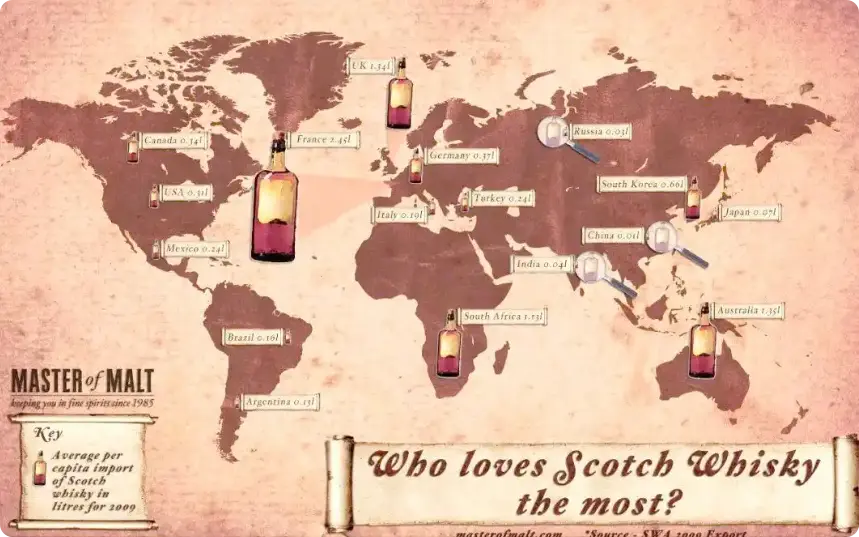
In the past 20 years, China's love for Scottish whisky has grown rapidly, and this trend is expected to continue. Although Baijiu dominates the Chinese liquor market, young and financially strong consumers are turning to Solvay. Chinese consumers are interested in Suwei's profound historical heritage and traditional craftsmanship. Many whiskey enthusiasts are willing to pay over £ 150 per bottle, with over 90% of them believing that single malt is the best quality spirits on the market. According to data from China Customs in 2021, the import volume of domestic whisky increased by 43.9% year-on-year, reaching 30.28 million liters, and the import value surged by 92%, reaching 460 million US dollars.